
Runu Rajput’s Family Needs a Safe Home After Assam Floods
Gohain Bari, Nazira, Sivasagar, Assam
Before the floods, Runu Rajput and her family lived a modest life in Gohain Bari, a low-lying area near the Dikhow River. Her husband, Dinesh Rajput, 44, worked as a daily wage labourer in a tea garden, earning approximately ₹6,000–7,000 a month. Runu managed the household and cared for their two children, who continued their education before and after the floods. The family also relied on a cow and poultry to supplement their livelihood.
Their bamboo house provided shelter and a place for everyday family life. But when the floodwaters entered their home, much of that security was lost.
The house was partially damaged, and the kitchen remains filled with mud. Beds, furniture, cooking utensils, clothes, bedding, food stocks, electrical appliances, school materials and other household essentials were lost. The family’s cow and poultry were also washed away, taking away an important source of supplementary income and support.
Dinesh continues to work in the tea garden, but without their livestock, the family has fewer resources to meet its daily needs. Rebuilding their home and replacing essential belongings will take time, especially while they continue to manage routine household expenses.
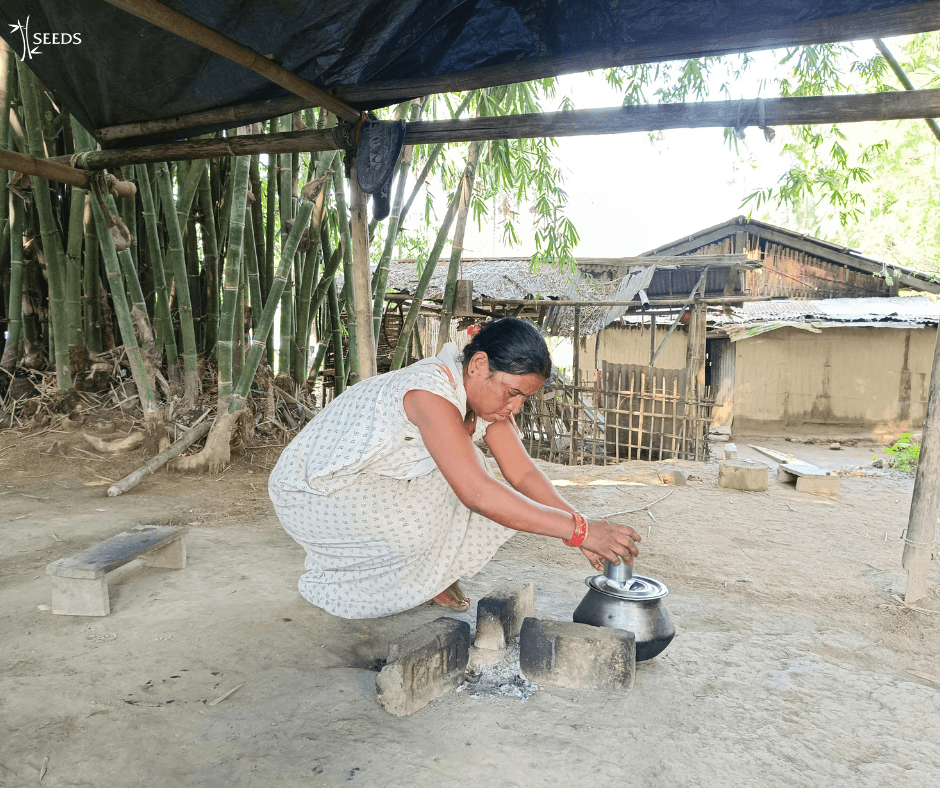
For Runu, one of the most immediate challenges is preparing meals. With the kitchen unusable, she has been cooking outdoors under a tarpaulin sheet.
“These days cooking in open. Put a tarpaulin sheet to protect from heat. Winter is also approaching,” Runu says.
The makeshift arrangement offers limited protection, but it is no substitute for a safe, functional kitchen. As winter approaches, the family must continue managing daily routines in a partially damaged home, with little certainty about when they will be able to restore a more secure living environment.
SEEDS and other organisations have provided food, household items, hygiene kits and utensil kits, helping the family address some immediate needs. However, repairing the house, restoring sanitation facilities and replacing lost belongings and livestock remain important priorities.
For Runu and Dinesh, recovery means more than repairing damaged walls. A safe home and functional kitchen would allow the family to resume everyday routines with greater comfort and dignity. Restoring sanitation facilities would help address health and hygiene concerns, while replacing the lost livestock could give the family another means of supporting its livelihood.
Over the next three to six months, they hope to repair their home, replace their livestock and create a safer, more stable environment for their children. Runu’s family is already taking steps towards recovery with the resources available to them.
Your support can help them rebuild a safer home and restore the essentials they need to move forward.
DONATE NOW
Your contribution will support SEEDS’ flood response and recovery efforts for affected families based on assessed needs.
Indicative Recovery Requirement
Based on an initial indicative assessment, Runu's recovery requirement could be around ₹1,50,000. Around ₹1,20,000 is indicated for repairing of bamboo house, durable rebuild. A further ₹20,000 is indicated for replacing the domestic animals lost, based on a typical small mixed holding for the area, to be confirmed through field verification. ₹20,000 is set aside for household utensils and essential items, and ₹40,000 for continued sanitation and drinking water support during the recovery period.
Recovery requirements and costs are indicative and subject to field and technical verification. Support will be prioritised according to assessed household needs.